

TEMA Successfully Completes Its Final Pilot Test in Mantoudi, Greece
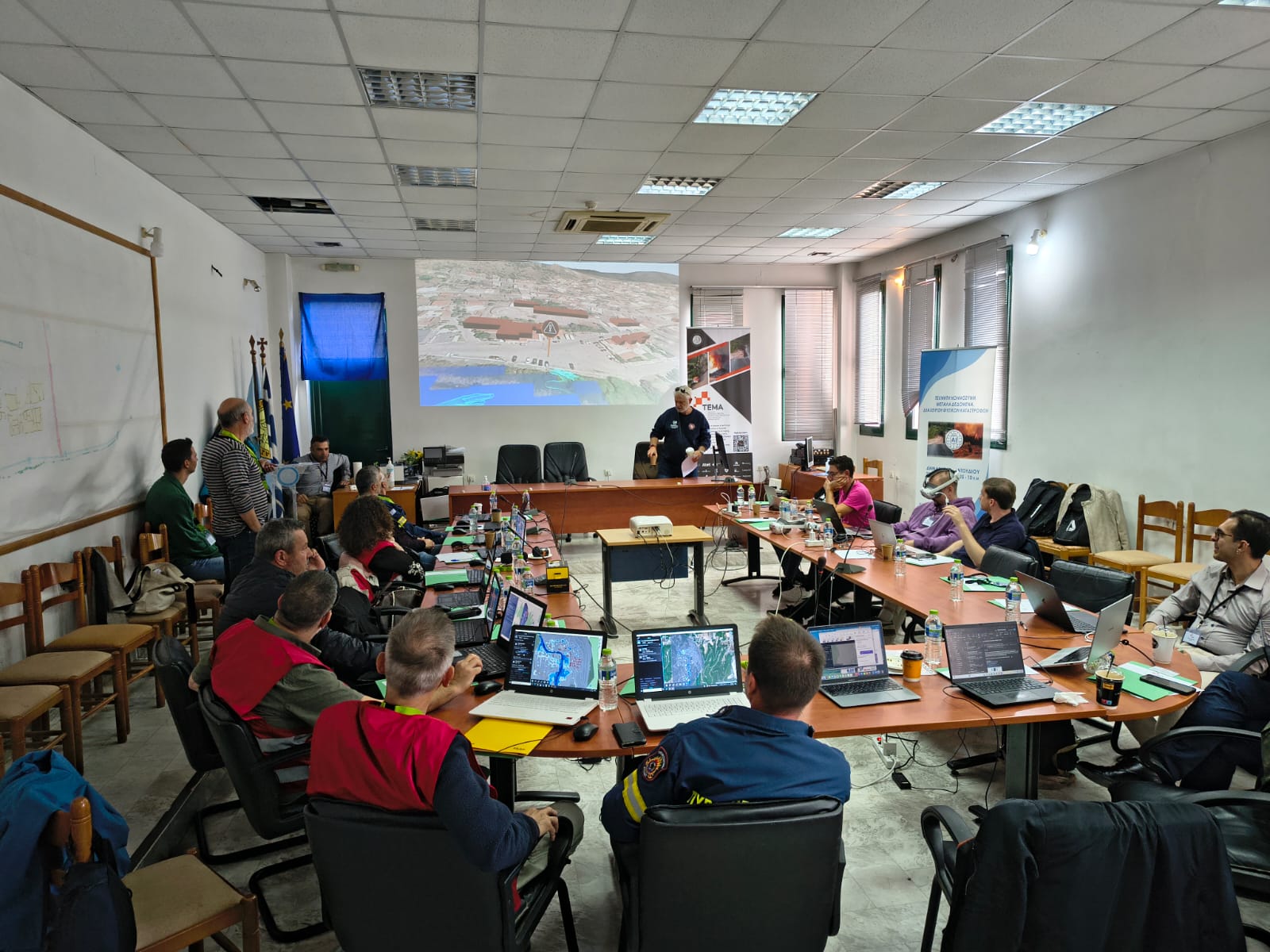
On 21 October 2026, the European Horizon Europe project TEMA (Trusted Extremely Precise Mapping and Prediction for Emergency Management) successfully completed its latest pilot test in Mantoudi, Evia, Greece. Hosted and co-organised by the Municipality of Mantoudi–Limni–Agia Anna (DMALIAN), the exercise brought together local and regional authorities, first responders and project partners to evaluate how the TEMA platform can support decision-making during natural disasters.
The pilot marked another important step in validating the platform’s capabilities in realistic operational scenarios, following seven previous successful pilot tests in Germany, Italy, Greece and Finland.
Bringing disaster scenarios to life
The Mantoudi exercise focused on a realistic hybrid simulation scenario based on the devastating Storm Elias floods of September 2023, complemented by recently recorded drone footage of severe weather events that affected the region between 13 and 16 October 2026.
This combination enabled participants to explore how the TEMA platform processes real-world field data to identify potential river overflow locations, map critical infrastructure and detect vehicles and people potentially trapped or at risk.
The exercise provided an opportunity for operational stakeholders to assess the platform's ability to bring together diverse information sources and present a unified operational picture in real time, supporting a clearer understanding of evolving disaster situations.
The event was attended by the Regional Deputy Governor for Civil Protection of Central Greece, Mr Pnevmatikos, the Regional Deputy Governor of Evia, Mr Kelaiditis, and the Mayor of Mantoudi–Limni–Agia Anna, Mr Tsapourniótis. Representatives of Civil Protection authorities at regional and municipal levels, the Fire Service, the Hellenic Police, the Evia Forestry Directorate and the Limni Forest Service also participated actively in the evaluation. All involved TEMA partners were represented, including Dr V. Mygdalis from Aristotle University of Thessaloniki.
Integrating technologies for better situational awareness
TEMA brings together a range of advanced technologies to support disaster prevention, preparedness and response. The platform combines:
- Artificial intelligence and big data analytics to process information from meteorological stations, satellites, drone imagery and social media.
- Predictive modelling and simulation to support the assessment of how floods and wildfires may evolve.
- 2D and 3D visualisation tools, accessible through the platform and virtual and augmented reality technologies, to help users interpret complex information and understand the potential impact of disaster scenarios.
By integrating these capabilities, TEMA aims to help emergency management authorities access relevant information, assess risks and coordinate their response more effectively.
The feedback from participating operational stakeholders was particularly positive regarding the platform's potential to provide a shared, real-time operational picture. This can help authorities better understand developing situations, identify areas of concern and support more informed decisions when time is critical.
Supporting first responders and emergency preparedness
Beyond its potential use during emergencies, the Mantoudi pilot highlighted the value of TEMA for training and preparedness exercises.
Participants emphasised the benefits of remote situational awareness, allowing authorities to assess potentially dangerous locations without necessarily having to visit them in person. This capability could help improve the safety of personnel while supporting the assessment of conditions on the ground.
The platform was also recognised as a potentially valuable training resource for newly recruited and seasonal firefighters. By helping personnel familiarise themselves with local terrain, geographical features and recurring hazards, TEMA can support a better understanding of the challenges they may face during an emergency.
These applications illustrate how advanced digital tools can contribute not only to immediate response operations but also to building preparedness and operational knowledge before a disaster occurs.
From testing to adoption
The successful completion of the Mantoudi pilot represents an important milestone in TEMA's efforts to validate its technologies in realistic disaster management settings. By bringing together technology developers and the authorities and first responders who may use these tools in practice, the exercise helped assess the platform's operational relevance and potential value for emergency management.
The results reinforce the importance of integrating data, predictive capabilities and visualisation tools into a common environment that supports the needs of those responsible for protecting communities and critical infrastructure.
As Europe faces increasingly complex risks from floods and wildfires, initiatives such as TEMA demonstrate how technological innovation can support the modernisation of civil protection and strengthen disaster preparedness at local and national levels.
TEMA continues to work towards bridging the gap between technological innovation and operational needs, helping move advanced disaster management solutions from testing towards adoption.