

BRK -Led Pilot Trial: Evaluating TEMA-System Performance in an Ahr Valley Flood Scenario
Margareta Mihalic Dogan, Project Manager at Bavarian Red Cross HQ
Uwe Kippnich, Security Research Coordinator at Bavarian Red Cross HQ
Bavarian Red Cross HQ / Stabsstelle Kommunikation
With the pilot trial conducted by the Bavarian Red Cross (BRK) on 04–05 November 2025 in Bad Neuenahr-Ahrweiler (Ahr Valley, Germany), the TEMA project successfully concluded the first cycle of four planned pilot trials. The scenario of this pilot was modelled on the extreme flood events that affected Western Germany in 2021, during which the Ahr Valley was identified as the epicentral and most heavily impacted area.
For the purposes of the pilot, the TEMA system was supplied with curated historical datasets from the 2021 Ahr Valley flood, spanning July to October, and supplemented by augmented imagery specifically generated for this trial by the TEMA partner ATOS. This combination of authentic and synthetic data created a high-fidelity test environment that allowed participants to engage with the system under conditions closely reflecting the real information pressures encountered by emergency management agencies during the actual disaster.
The pilot commenced with a field visit for TEMA partners and on-site participants to several of the locations most severely affected by the 2021 flood. Guided by local rescue professionals, who had served as first responders during the original event, the group visited the areas most severely affected by the flood and learned about the events and challenges that unfolded during the disaster, as well as situational complexities that shaped the emergency response. Seeing these sites firsthand gave the TEMA development teams useful insight into the challenges of real disasters and highlighted the relevance of their work, showing how their efforts could support situations like the Ahr Valley flood.
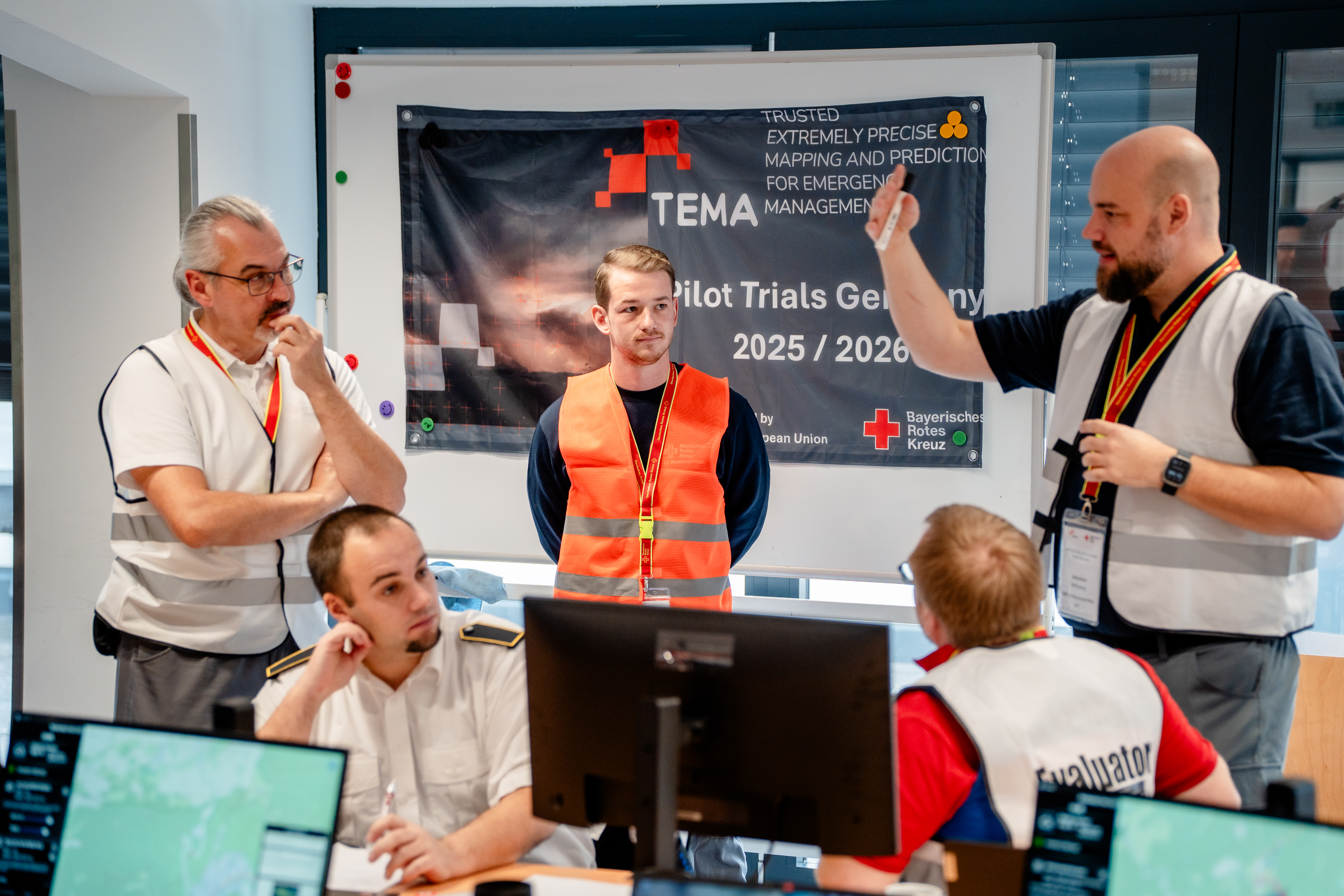
On 05 November 2025, seven highly experienced experts from rescue services, first-response units, and command-and-control centers participated in the formal evaluation session. Representing the German Red Cross, the Federal Agency for Technical Relief (THW), mountain rescue services, and civil protection authorities—and bringing diverse expertise in rescue operations, leadership structures, communications, and IT—they engaged in a structured three-hour scenario trial based on the Ahr Valley flood. The Bavarian Red Cross pilot was conducted as a non-field activity based on historical data.
Using the information provided by the TEMA platform, the experts developed situational awareness, assessed evolving risks, and planned coordinated response actions. In total, 22 of the 28 TEMA components were activated and evaluated during this pilot.
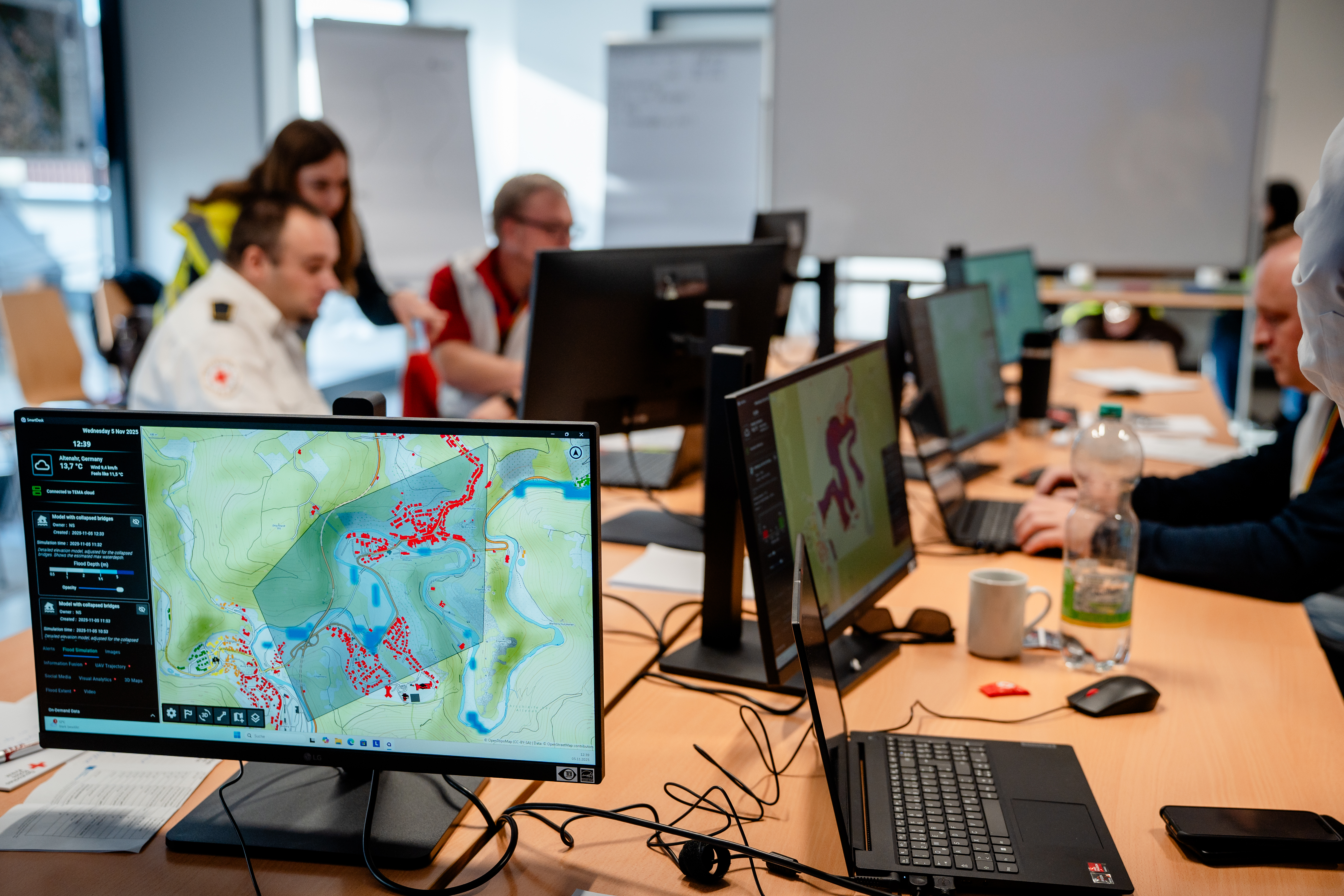
The extended evaluation from the participating end-users highlighted several strengths of the TEMA system. In particular, the experts praised its high degree of information fusion, most notably the integration of drone imagery, social media analytics, geotagging, and predictive modelling tools—which supported faster identification of critical developments compared to traditional situational assessment methods. At the same time, the evaluators identified several usability limitations and offered targeted recommendations for improvement, thereby providing essential guidance for the next phase of system refinement.
Beyond the practical pilot results, TEMA has also generated a number of valuable research insights. The project has explored approaches to multimodal data fusion, aiming to integrate diverse information sources—such as satellite data, UAV imagery, and social media content—into a coherent operational picture. Initial methods for event detection, geospatial correlation, and impact estimation have been developed and examined across several disaster scenarios. In addition, TEMA has been investigating how AI-derived outputs can support expert decision-making and how human–machine collaboration can be structured in time-critical environments. These findings contribute to the ongoing development of the platform and provide a solid basis for future research in data-supported disaster management, with early results indicating promising potential.
BRK State Director Robert Augustin emphasized the strategic importance of the project, stating: “The Bavarian Red Cross, together with all project partners of TEMA, is preparing for future disasters that will need to be managed. It is essential that we are better prepared than before—and we are continuously conducting research to achieve this. Through the international TEMA project, we are particularly exploring digital pathways to provide our emergency services with the best possible support across the country.”