Background Image for header that show a weather storm
tema logotipo
Home

Main navigation

  • Home
  • About
    • Description of the project
    • Partners
    • Governance
    • Glossary
  • Cluster
  • Pilots
  • Outcomes
    • Datasets and Publications
    • Public deliverables
    • Academic Contents
    • Dissemination materials
    • Videos
  • Updates
    • Articles
    • News
    • Events
    • Newsletters
  • Contact
  1. Home
  2. Fire Spread Models

fire spread models

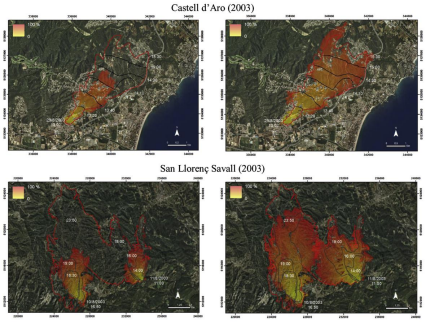
Time elapsed of free simulated fire growth (left) and adjusted simulated fire growth (right) considering the adjustment factors.

Adjusting the Rate of Spread of Fire Simulations in Real-time

Thu, 14/03/2024 - 10:00
This article explores the use of fire simulation and modelling for predicting fire spread based on literature review.
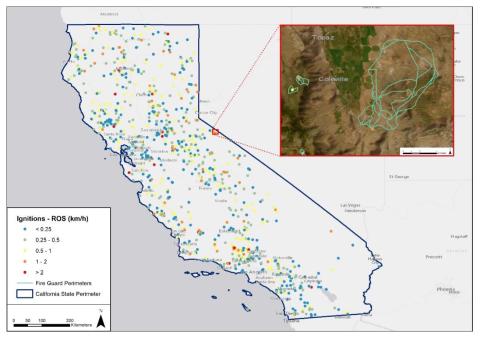
Wildfire ignitions retrieved from FireGuard in California from October 2019 to November 2021. Each fire has an associated rate of spread (ROS) for the first burning period (up to 8 h) obtained by averaging the ROS of all FG polygons by incident. The zoomed-scale box shows three fires with the associated FG polygons for the burning period (the largest fire is the Mountain View fire).

Performance of Operational Fire Spread Models in California

Mon, 06/11/2023 - 09:00
Wildfires are a natural disturbance that shape the ecosystems and landscapes (Pausas and Keeley 2009) although they are a growing threat to the environment, economical assets and population in many regions worldwide (Molina-Terrén et al. 2019). In fact, substantial amounts of financial resources have been invested in fire management aiming to reduce the damage associated with unintended consequences of wildfires and improve safety for the population (Cardil and Molina 2015; Stocks and Martell 2016). Fire agencies rely on suites of wildfire analysis products that are designed to meet the needs of operational response and mitigation planning. Given the challenges that first responders and decision-makers were faced with to adequately predict fire spread and potential impacts, and dispatch the most appropriate resources every time a wildfire is detected in California, California Department of Forestry and Fire Protection (CAL FIRE) (2019), through a request for innovative ideas in March 2019, selected Wildfire Analyst Enterprise (WFA-e) to evaluate initial attack fires and calculate wildfire risk based on automatic simulations.
Subscribe to fire spread models
Tema logo

Contact us

info@temaproject.eu

Join our newsletter

CC-BY Licence

Footer Links

  • Privacy
  • Cookies
  • Glossary
  • Accessibility Statement
  • Sitemap
EU Funded This project has received funding from the European Union’s HE research and innovation programme under the grant agreement No. 101093003