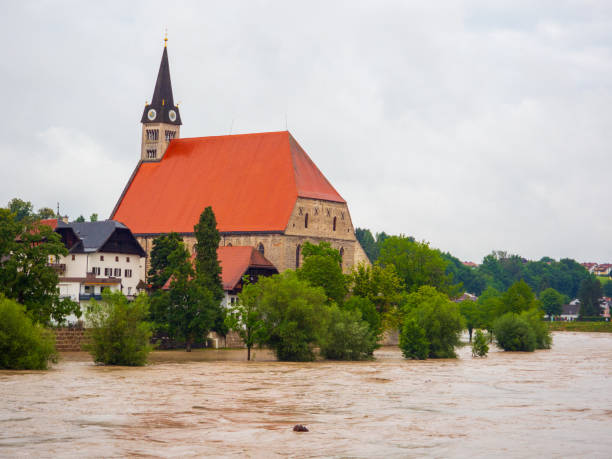

Central-European Regional Floods (Germany)
Central Europe has many big rivers and, for climatic reasons, can experience heavy persistent rains. For example, Bavaria (pilot site) and Germany have many rivers of varying size with an added-up length of about 100.000 km (e.g., Danube, Rhine, Main and Elbe). Severe rain will cause regional floods: the rivers to swell, break dams, flood the area and damage infrastructure. The First Responders (FRs) often lack sufficient information regarding the scale of the flooding event, the size of the affected area and the number of the affected people. Information about the accessibility to settlements in an affected area is crucial for the mission planning and FR reaction.
As a consequence of a lengthy and severe rain in July 2021, several villages in the German pilot-region Ahrtal were flooded. It was the most severe flood in this region of Germany in the last 100 years. This led to many search-and-rescue missions, also involving BRK, that still went on after five days. Roads and bridges were destroyed in the floods. The Ahrtal is a valley situated within a low mountain range, making it vulnerable to floods, which are expected to occur more frequently in the future due to climate change. The flood model will be set-up for the area and will be calibrated based on information retrieved from historic flood events, including a wide range of multimodal data collected and produced by DLR during the Ahrtal flood. TEMA tools and services will provide information which will be used to warn the responsible authorities, population and PPDRs, and provide information about the accessibility of the affected region (regarding roads, bridges, etc.) leading to improved NDM.
First pilot in Germany
The first German pilot trial was conducted by the Bavarian Red Cross (BRK) on 04–05 November 2025 in Bad Neuenahr-Ahrweiler (Ahr Valley, Germany) and focused on improving preparedness and coordination during large-scale regional flood events through the use of the TEMA platform. The exercise demonstrated how integrated data sources — including satellite imagery, simulations, sensor information and geospatial analytics — can support decision-makers in obtaining a more comprehensive operational picture during rapidly evolving flood scenarios. Particular emphasis was placed on situational awareness, information sharing and faster access to critical data for emergency responders and civil-protection authorities.
The trial confirmed the value of combining heterogeneous data into a single operational platform, while also identifying areas for further development ahead of the next pilot phase. Feedback from end-users highlighted the importance of improving dynamic simulations, strengthening interoperability with existing systems and enhancing real-time operational coordination. The results will inform the next stage of development, focusing on more precise forecasting, improved usability and stronger support for cross-border and multi-agency emergency response planning.
The next pilot iteration will take place in fall 2026.
Bayerisches Rotes Kreuz